Raising venture capital usually starts the same way for most founders. You send a cold email. You wait. You hope someone answers. Founders & Funders is trying to fix that. Instead of founders chasing investors, F&F puts the right founders and the right VCs in the same room and lets the relationship do the work, not the pitch deck.
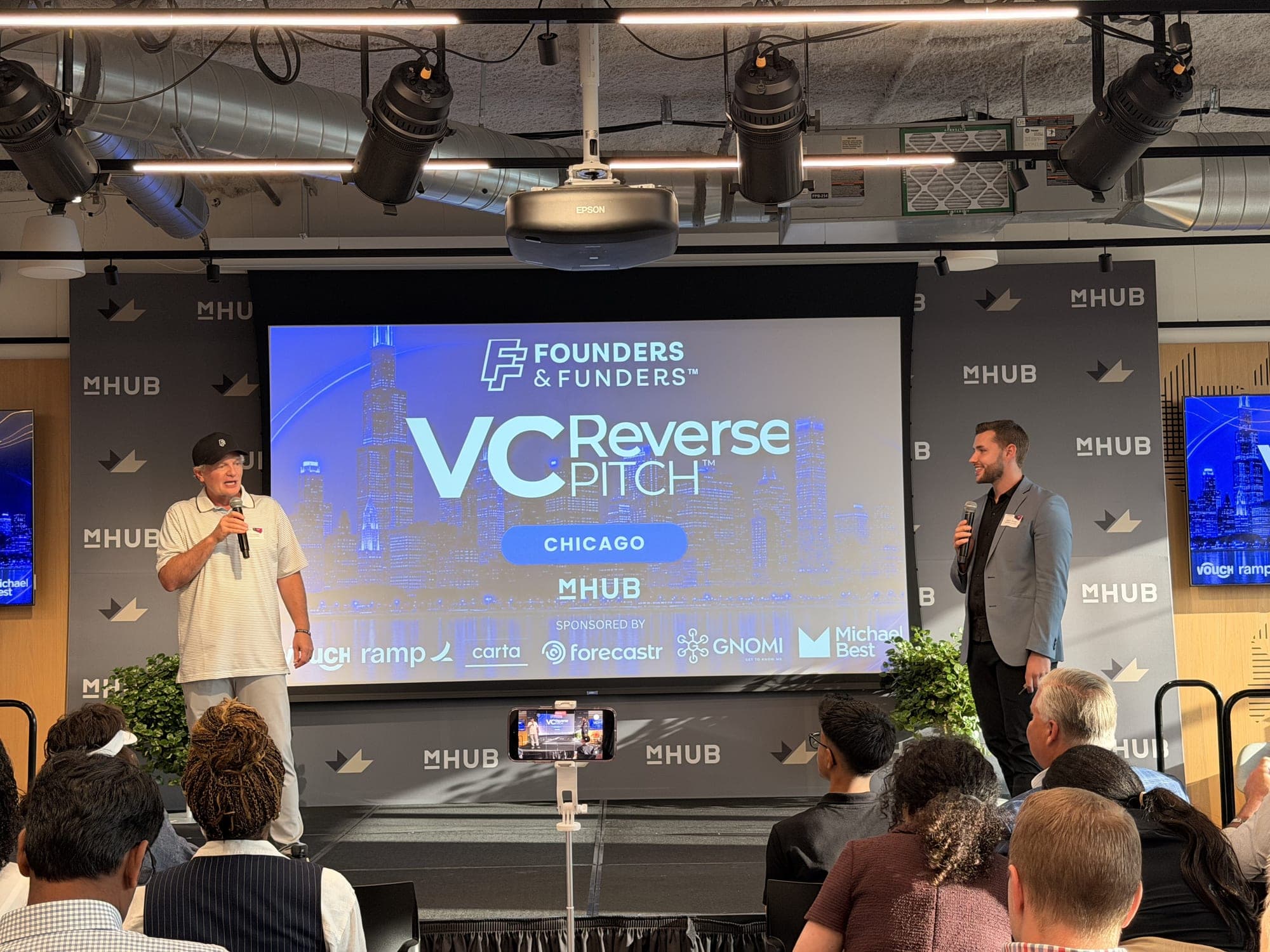
That is exactly what happened at F&F's VC Reverse Pitch Night in Chicago, hosted at mHUB, and the energy in the room made it clear something different was happening.
“You have good people helping good people,” said Jason Camosa, an active angel investor in Chicago who has been to more of these nights than most. “I believe the Chicago ecosystem is very underrepresented, and events like these are gonna bring them closer together.”
What happens at a VC Reverse Pitch
The idea is simple. Instead of founders pitching investors, eight VCs got up and pitched themselves. Each one had four minutes to share what they invest in, how big their checks are, and what they actually look for in a founder before writing one. The night was backed by sponsor partners Vouch, Michael Best, Carta, Forecastr, GNOMI, and Ramp, all of them offering tools founders actually need once the money is in the bank, not just a logo on a slide.
Vlad, founder of StackBooster, an AI powered Kubernetes orchestrator, said the format gave him more than he expected walking in. “The guys that presented today were so detailed about their philosophy, their specific unique traits, what they're looking for in portfolio companies, what they deliver, what they can bring to the table. I found a lot of interesting insights that we need to change in our model. Kudos to organizers. You guys did a pretty good job of bringing all these guys into one room.”
What each VC wants founders to know
Nick Moran of New Stack Ventures told the room to pick an investor who believes in your mission, not just the one writing the biggest check. He built a podcast out of his own struggle to raise money, and 34 founders he has backed have gone on to raise their next round from someone they met as a guest on that show.
Rob Chensey of Chicago Ventures said founders should look for investors who understand how hard building a company really is and who show up as real partners, not silent checks. His fund leads or co-leads most of its deals, meaning they are in the room with founders long after the money is wired.
Carlos Covarrubias of Hyde Park Venture Partners said the AI companies that win are not just “AI for this” or “AI for that.” They win because they own real data, hard to build integrations, or a much simpler user experience than anyone else in their space. He even built his own pitch slide live using AI to make the point.
Jason Pritzker of Fifty Three Stations said what matters most is not which industry you are in, it is the strength of your network. He looks for founders with a clear vision, the ability to move fast, and a knack for hiring great people.
Ashley Ryder of Vamos Ventures said backing diverse founding teams is not a side project for her fund, it is the whole point. She tracks things like board diversity and hiring alongside financial returns and calls her fund family on the cap table.
Mark Phillips of 11 Tribes Ventures said building a big business should never come at the cost of a founder's own wellbeing. His fund commits 2 percent of every dollar it invests directly toward a founder's mental health and personal growth.
Danny Pantuso of Mucker Capital said great founders do not wait around for funding to prove they can sell. He wants to see revenue first, even if it is just a couple thousand dollars a month, and he specifically looks outside the Bay Area for founders other investors overlook. Almost every early company his fund backs goes on to raise another round.
Jordan Freibrun of SixThirty said his fund's edge comes from the big companies behind it. Because SixThirty is backed by major banks and insurers, it can connect its portfolio companies directly with real customers and real revenue, not just capital.
The founders in the room
What made the night feel different was not just who was on stage, it was who was listening.
Kirsten Kartshmer, founder of Conceivable, is building the first operating system for women's health. “This has been a great event with so many interesting investors, and it's glad to have them on the stage instead of us,” she said.
Jessica Lang, founder of Royce+Reign, felt the same pull. “This is a really great event. It's super energizing. There's a lot of really great talent and interesting people in the room, and it's a great way to meet new people.”
Bob Gorman, CEO of Serendipity Frozen, put it simply. “Been a great event, heard a lot of great advice for founders, and excited to talk to some of the VCs that are here.”
Christine Lemieux, co-founder and COO of Caviar Dream, noticed something worth sharing too. “So many people in the room are really energized to share what they're doing with their company, or share how they're working with the VC and how they can support us. While it seems a little bit tech dominated, we did speak to someone who is interested in being a VC to CPG companies, and that is really exciting for us.”
And not every founder left ready to raise, which is its own kind of honest takeaway. Trish Oswald of Brisa Systems said, “This was a wonderful event. I learned so much. I don't think I'm quite ready for VC, but I've learned a lot, and I'll be ready next time.”
Beyond the pitches
Founders & Funders co-founders Jeff Erickson and Adam Shaw also shared an update on their own fund, FNF Ventures. In the past three months alone they have written 12 checks, with 20 more planned in the next 30 days. It is a sign of where F&F is heading, not just hosting the room, but investing in the founders who walk into it.
Why it works
Cold outreach rarely gets a response. A room built around real fit almost always does. That is the idea behind every F&F event, and Chicago proved it works.
Want to be in the next room? Join the list →